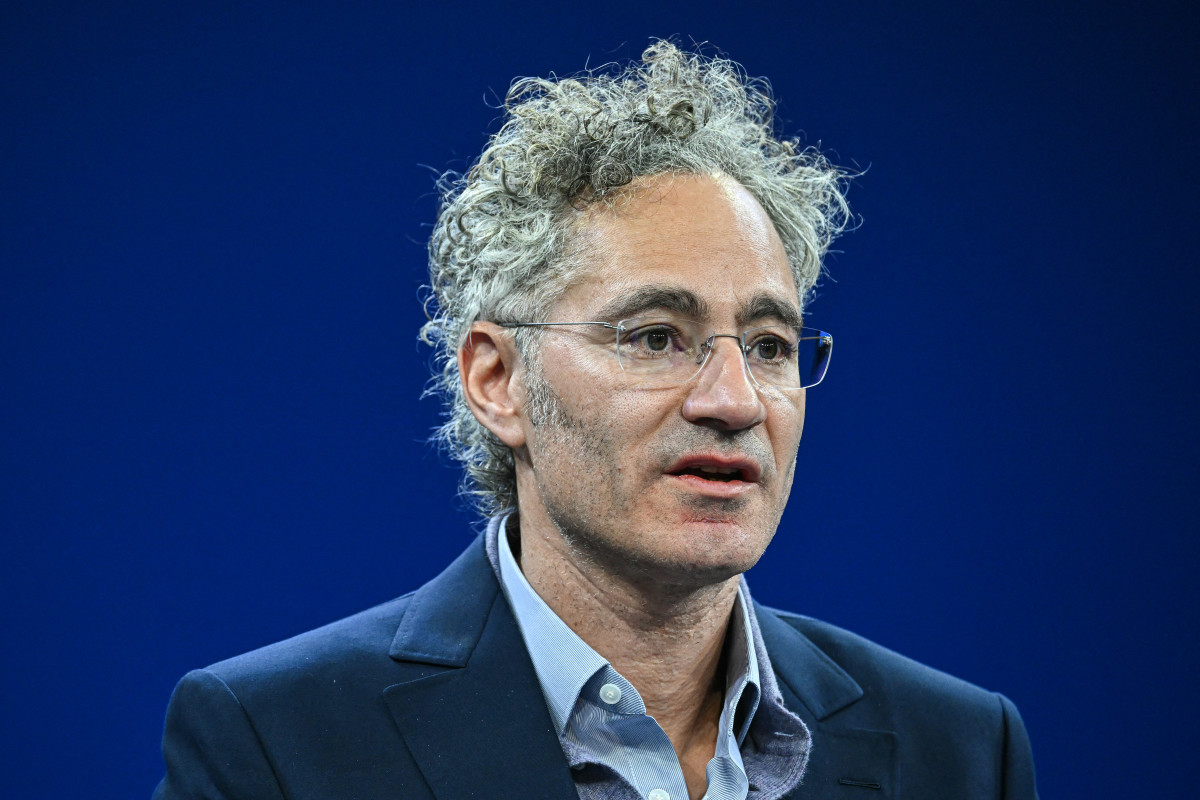
Palantir CEO delivers curt 8-word message to investors
That’s the blunt eight-word line Palantir (PLTR) CEO Alex Karpis telling investors to use when thinking about how to value Palantir.
Karp’s rationale came fast.
For perspective, Palantir delivered a superb 70% aggregate revenue growth in Q4, spearheaded by 93% growth in the U.S. alone, along with a stellar Rule of 127 score (a combination of sales and operating profit margins). These numbers, Karp feels, warrant a separate bucket for Palantir stock.
The market bought the argument, at least initially, where the stockpopped 6% to 7% post-earnings.
Moreover, the Wall Street punditry followed it up with meaningful resets.
Citigroup analyst Tyler Radke kept a Buy rating while bumping his price target on the stock from $235 to $260.
Additionally, Piper Sandler analysts echoed a similar sentiment, tweaking their price target from $225 to $230, leaning heavily on “quality of growth”.
Hence, as AI models commoditize, Palantir sees the real premium effectively shift to implementation, control, integration, compliance, and speed to production.
If Palantir can nail that thesis consistently, the“N-for-1” argument will continue pushing its stock to new heights.
Revenue, earnings snapshot (past four quarters)
- FQ4 2025 (Dec 2025) — $1.41 billion (+70% year-over-year) — EPS: $0.25 — Beat/Miss: +$0.02.
- FQ3 2025 (Sep 2025) — $1.18 billion (+62.79% year-over-year) — EPS: $0.21 — Beat/Miss: +$0.04.
- FQ2 2025 (Jun 2025) — $1.00 billion (+48.01% year-over-year) — EPS: $0.16 — Beat/Miss: +$0.02.
- FQ1 2025 (Mar 2025) — $883.86 million (+39.34% year-over-year) — EPS: $0.13 — Beat/Miss: $0.00.
Source: Seeking Alpha
Karp says Palantir is playing a different AI game
Karp’s sharp take is essentially about to redraw the competitive map around Palantir.
More Palantir
- Bank of America updates Palantir stock forecast after private meeting
- US Navy bets $448M on Palantir AI to speed shipbuilding
- Palantir secures quiet contract win with big implications
- Michael Burry shares bold predictions for OpenAI, Palantir
A big part of that is that Karp wants Palantir judged differently than a typical enterprise software business.
Palantir’s differentiator isn’t just one AI model, but an entire stack that makes those models usable within often massive, regulated institutions.
As many AI models become more cost-effective and commoditized, Palantir believes the dynamic actually helps it on its journey.
At the heart of it all is execution, with Karp pointing to an industry that’s stuck in the mud in many ways. On the flip side, Palantir is working to compress time-to-value while pushing AI into real-world operations.
In that realm, the big winners are businesses that can safely connect AI to sensitive data, control permissions and workflows, while turning outputs into real decisions. Moreover, Palantir doesn’t need a laundry list of new customers each quarter to continue dishing out the big numbers.
On top of that, Karp also made a geopolitical statement: AI will likely create “haves and have-nots,” and Palantir is looking to be the infrastructure powering the institutions that can’t afford to get it wrong.
Palantir stock returns from YTD through 5 years
Palantir’s stock had a tremendous 2025, but lately it’s been under considerable duress.
Related: Top analyst drops eye-popping new price target on SanDisk stock
That said, Wall Street’s average price target for Palantir Technologies is at $190.75, implying nearly 21% upside from current levels.
However, it’s important to note that the target range is wide, roughly $70 on the low end to $260 on the high end.
- YTD: -11.18%
- 1Y: +91.39%
- 3Y: +1,656.17%
- 5Y: +408.96%
Source: Seeking Alpha
Palantir just posted the kind of quarter that changes narratives
Palantir’s Q4 performance was impressive to say the least, delivering the kind of quarter investors welcomed after multiple relatively quiet months.
Related: Morgan Stanley delivers blunt verdict on Fed pick Warsh
Revenue skyrocketed to 70% year-over-year to $1.41 billion, blowing past Wall Street’s expectations, with growth jumping 19% sequentially.
The story was overwhelmingly domestic.
U.S. sales went parabolic, rising 93% to77% of total sales, while U.S. commercial revenue soared 137%. Government revenue wasn’t a laggard by any means, rising 66%, underscoring Palantir’s multi-dimensional growth engine.
The forward indicators grew even louder.
The commercial total contract value jumped to $2.6 billion, up 161% while net dollar retention rates surged to 139%, with remaining deal value more than doubling to $11.2 billion.
Customer count rose 34%, with Palantir’s management pointing to 61 deals over $10 million, reinforcing the company’s hold on the big-ticket clients.
Crucially, Palantir continues to scale its business profitably.
Adjusted operating income jumped to $798 million, yielding a 57% margin, while free cash flow totaled $791 million (a superb 56% margin). Then came guidance, projecting nearly 61% growth for 2026, well ahead of consensus.
Palantir’s blowout quarter came with a catch
Clearly, Palantir dished out tremendous numbers, but there’s still real risk to consider, even after an inch-perfect quarterly showing.
First up, there’s valuation.
Palantir trades at far richer multiples than its traditional SaaS peers, leaving virtually nothing in the way of execution hiccups. For perspective, Palantir stock trades at more than 144 times forward non-GAAP earnings and about 180 times forward GAAP earnings.
On top of that, expectations are incredibly high for the business, and even a modest slowdown in top- and bottom-line numbers could severely impact the stock.
Also, nearly three-quarters of its sales come from the U.S., tying results to federal budgets and domestic enterprise AI spending. Though that has proven to be a potent tailwind when the conditions are right, it can clearly cut both ways if procurement timelines slip or we see tightness in commercial budgets.
Moreover, despite commercial demand rising at an incredible rate, scaling AI deployments isn’t free by any means. The company’s management has flagged rising costs, and stock-based compensation remains elevated, testing investor patience if margins dip.
Related: Veteran analyst delivers surprise verdict on Tesla, Nvidia