Bybit Maps Out Push Beyond Crypto Trading
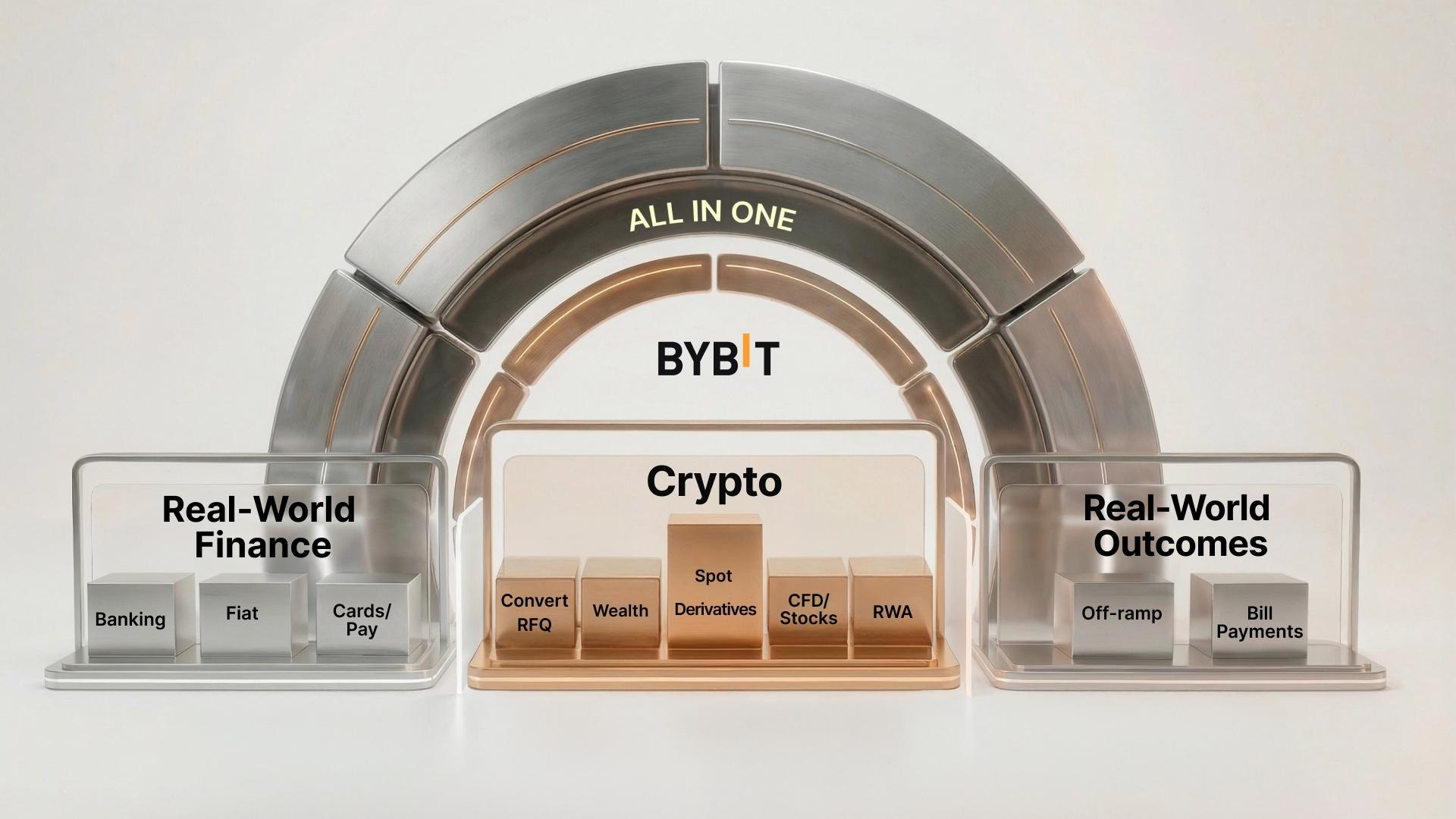
Bybit is planning its next phase. Speaking in Dubai this week, co-founder and CEO Ben Zhou said the company intends to reposition itself by 2026 as a broader financial platform, moving past its role as a crypto exchange and into banking, payments, custody, and traditional markets.
The pitch is straightforward: crypto as infrastructure, not a niche product. Bybit says the goal is to build a single system where digital assets, fiat money, and traditional investments operate side by side.
Why Bybit is changing direction
Crypto exchanges are under pressure. Trading volumes are cyclical, regulation is tightening, and competition is no longer limited to other exchanges. Fintech apps, banks, and payment firms are moving into the same territory.
Bybit’s response is to expand horizontally. Instead of relying mainly on derivatives and spot trading, the company is trying to anchor users inside a wider financial stack that includes payments, savings, yield products, and access to traditional markets.
Zhou framed the shift around financial access, pointing to the estimated 1.4 billion people worldwide who remain underbanked. The idea is that blockchain-based systems can deliver faster, cheaper services in regions where traditional banking is slow or limited.
Investor Takeaway
Banking and custody move into focus
One of the more concrete announcements is MyBank, a retail banking layer scheduled for launch in early 2026. Bybit says the service will offer dedicated accounts for fiat transfers, cross-border payments, and daily transactions, operating under existing compliance frameworks.
The product is aimed primarily at users in emerging markets, where access to reliable banking remains uneven. Bybit’s pitch is that combining crypto liquidity with banking rails can reduce fees and settlement times.
On the institutional side, Bybit is expanding its custody business. Its ByCustody platform currently secures more than $5 billion in assets for over 30 asset managers. The company says more than 2,000 institutions now use its infrastructure, double the number from a year ago.
How big the platform already is
Bybit enters this transition with scale. The company reports more than 82 million users across 181 countries, connections to nearly 2,000 banks, and over 58 fiat gateways.
Its payments and access tools include more than 200,000 P2P merchants, 2.7 million issued cards, and local payment support in more than 10 countries. Bybit Earn manages $7.1 billion in assets and generated roughly $110 million in yield for users last year.
The company has also pushed further into traditional markets. Bybit TradFi, launched in 2022, now supports over 200 instruments and is set to expand to 500 trading pairs, including stock CFDs, forex, commodities, and indices.
Investor Takeaway
Regulation and automation as the backbone
Bybit says its expansion is being built alongside regulators and licensed partners. The company is working with banks and custodians to tighten onboarding, custody standards, and transaction monitoring.
Automation is another focus. Bybit plans to expand the use of AI across engineering, compliance, risk, and customer support, building on internal tools that it says have already improved productivity.
Whether Bybit’s strategy works will depend on execution and regulatory outcomes. But the direction is clear. The company is betting that the future of crypto exchanges looks a lot more like financial infrastructure than trading venues.