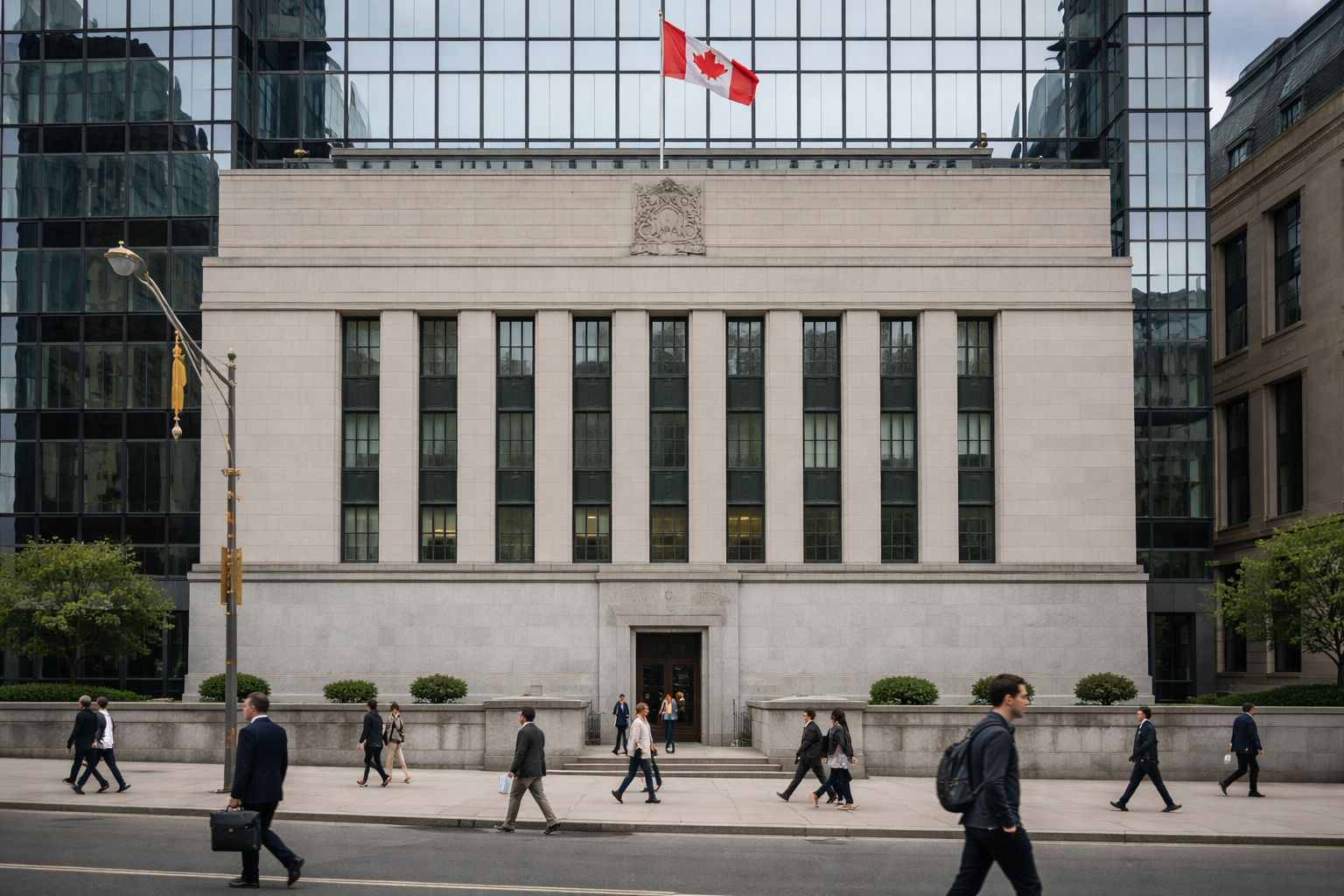
Bank of Canada holds rates at 2.25% as global risks cloud outlook
The Bank of Canada held its benchmark interest rate steady on Wednesday, signaling a cautious approach as policymakers balance rising energy-driven inflation pressures against weakening economic growth.
Officials led by Governor Tiff Macklem kept the policy rate unchanged at 2.25%, in line with market expectations and economist forecasts.
The decision comes amid heightened uncertainty linked to the Middle East conflict and its potential impact on global energy markets.
In its policy statement, the central bank emphasized that it could not predict the duration or scale of the Iran conflict, describing the economic outlook as “highly uncertain.”
Central bank looks through near-term inflation pressures
The Bank of Canada indicated it would “look through” the immediate inflationary effects of higher energy prices, while remaining vigilant about longer-term risks.
“The risk that higher energy prices quickly spread to the prices of other goods and services looks contained,” Macklem said in prepared remarks.
The bank noted that inflation remains close to its 2% target and that the economy continues to operate with excess supply, which may help limit broader price pressures.
“Governing council will look through the war’s immediate impact of inflation but if energy prices stay high, we will not let their effects broaden and become persistent,” Macklem said.
At the same time, policymakers removed language from previous guidance that had suggested the current policy rate “remains appropriate,” instead stating they “stand ready to respond as needed.”
Growth concerns intensify amid economic weakness
While inflation risks are being monitored, the Bank of Canada signaled greater concern about the outlook for economic growth.
Officials said it is “too early to assess the impact of the conflict in the Middle East on growth,” but added that “risks to growth look tilted to the downside.”
Recent economic data points to softening conditions.
Canada lost 83,900 jobs in February, marking the largest monthly decline in four years, while the unemployment rate rose to 6.7%.
The economy also contracted at an annualized rate of 0.6% in the fourth quarter.
Governor Macklem acknowledged the difficult trade-offs facing policymakers.
“Economic weakness combined with rising inflation is a dilemma for central banks,” he said.
“Raising interest rates to slow inflation could further weaken the economy. Easing interest rates to support growth risks pushing inflation well above target.”
Additional headwinds include slowing population growth, subdued business investment, and ongoing trade tensions with the United States.
Oil shock creates mixed impact for Canadian economy
The central bank highlighted the complex effects of rising oil prices on Canada’s economy, which is both an energy exporter and a consumption-driven market.
Higher oil prices can boost government revenues and corporate earnings in energy-producing regions.
However, they also raise gasoline prices, reducing household spending power.
Macklem said that while a sustained increase in oil prices would “boost income from energy exports,” higher fuel costs would “squeeze consumers, leaving them with less income for other spending.”
Policymakers also warned that disruptions in the Strait of Hormuz could impact broader commodity supplies, including fertilizer, adding to inflationary pressures.
For now, the central bank appears set to remain on hold as it assesses how long energy-driven inflation pressures persist and how deeply they affect economic growth.
The post Bank of Canada holds rates at 2.25% as global risks cloud outlook appeared first on Invezz