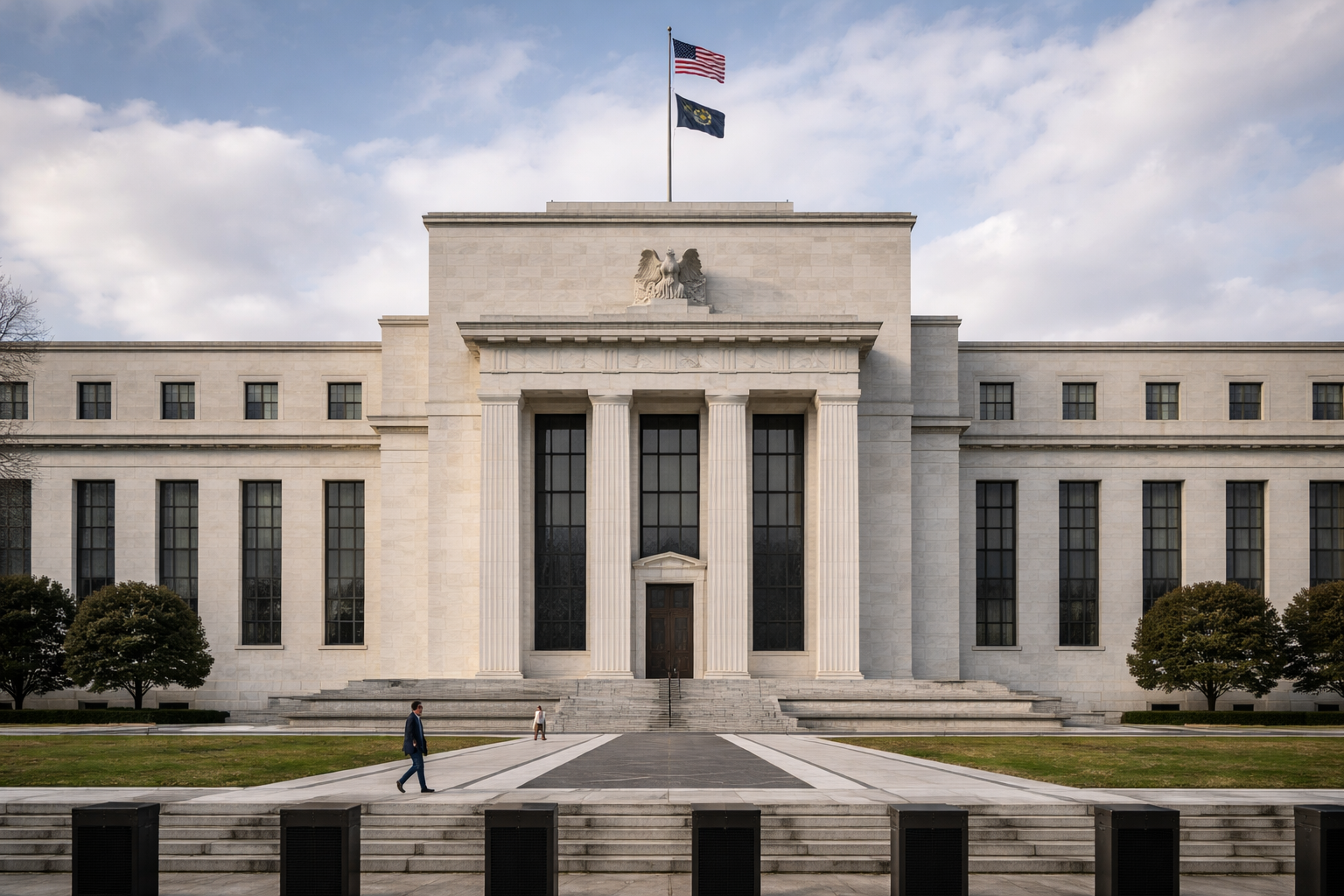
Fed holds rates steady as Middle East war clouds outlook
US Federal Reserve officials left interest rates unchanged on Wednesday, maintaining a cautious stance as geopolitical tensions in the Middle East and mixed economic signals complicate the policy outlook.
The Federal Open Market Committee (FOMC) voted 11-1 to keep the benchmark federal funds rate in a range of 3.5% to 3.75%, in line with market expectations.
Governor Stephen Miran dissented, calling for a quarter-point rate cut.
The decision marks the second consecutive pause by the central bank, though the economic backdrop has shifted notably since its previous meeting.
Fed flags uncertainty amid Middle East conflict
Federal Reserve Chair Jay Powell said the Middle East conflict is expected to lift near-term inflation, but added that it remains “too soon to know the scope and duration” of its economic impact.
“Near-term measures of inflation expectations have risen in recent weeks, likely reflecting the substantial rise in oil prices caused by the supply disruptions in the Middle East,” he said during a press conference following the policy decision.
In its post-meeting statement, the Fed highlighted growing uncertainty tied to geopolitical developments.
“The implications of developments in the Middle East for the US economy are uncertain,” officials said. “The committee is attentive to the risks to both sides of its dual mandate.”
The escalation in conflict following US-Israeli strikes on Iran has pushed oil prices higher, raising concerns about inflation while also posing risks to economic growth and employment.
Despite these pressures, policymakers indicated they are not yet prepared to adjust rates, instead opting to monitor how evolving conditions affect the broader economy.
The central bank also maintained its forward guidance, with projections continuing to show one rate cut in 2026 and another in 2027.
Notably, no officials signaled a preference to raise rates this year.
Labor market language shifts as risks emerge
The Fed made subtle but important changes to its assessment of the labor market.
Officials removed earlier language suggesting stabilization in employment conditions, instead noting that the unemployment rate has been “little changed in recent months.”
This adjustment follows a weaker-than-expected February jobs report, which raised questions about the resilience of the labor market.
At the same time, the Fed reiterated that “job gains have remained low,” while maintaining its view that economic activity “has been expanding at a solid pace” and that inflation “remains somewhat elevated.”
These mixed signals underscore the balancing act facing policymakers as they weigh risks to both inflation and employment.
Updated forecasts show higher inflation outlook
Alongside the rate decision, the Fed released updated economic projections that reflected modest changes to its outlook.
Policymakers slightly raised their forecast for 2026 economic growth to 2.4%, up from 2.3% previously, while keeping their unemployment projection unchanged at 4.4%.
However, inflation expectations were revised higher.
Officials now see inflation at 2.7% by the end of 2026, up from a prior estimate of 2.4%.
Core inflation, which excludes food and energy, is also projected to reach 2.7%.
The upward revision reflects concerns that rising energy prices could feed into broader inflation, even as central bankers traditionally view such shocks as temporary.
Investors have adjusted their expectations accordingly.
While markets still anticipate one rate cut by the end of the year, expectations for earlier easing have been scaled back.
The Fed’s cautious stance comes as it navigates a complex environment shaped by geopolitical risks, inflation pressures, and signs of labor market softening.
The post Fed holds rates steady as Middle East war clouds outlook appeared first on Invezz