Mideast turmoil exposes India’s weak LPG logistics; eateries face the heat
Even as the Indian government reassures citizens that the supply of domestic cooking gas remains uninterrupted, uncertainty prevails.
Experts believe shortages of liquefied petroleum gas (LPG) will likely remain.
“Shortages will likely persist for as long as the kinetic conflict remains active,” Igor Isaev, doctor of technical sciences, head of analytics center at Mind Money, told Invezz.
“The duration for which India can weather the current headwind from the Middle East is rather short.”
Deepening reliance and supply headwinds
India produces only about 40% of its LPG requirement domestically, leaving roughly 60% to be met through imports. The world’s second-largest importer of LPG gets 90% of its imports from the Middle East.
Hotels and restaurants are currently experiencing an indefinite gas-crunch even as the government focuses its priorities on 332 million households.
“When it comes to India’s LPG crisis, the hospitality sector may become the sacrificial lamb at the altar of broader domestic supply stability,” Isaev said.
The Ministry of Petroleum and Natural Gas assured the public on Tuesday that the cooking gas supply is steady and advised citizens against panic buying.
During a press briefing, Sujata Sharma, joint secretary (Marketing & Oil Refinery), noted that recent enforcement efforts have included conducting about 12,000 raids and seizing approximately 15,000 cylinders.
Domestic LPG bookings have improved despite the ongoing concerns regarding the overall supply situation.
To bolster supply, the government is looking into expanding the PNG pipeline infrastructure.
Furthermore, officials confirmed that the movement of fuel shipments is under strict surveillance, noting the recent arrival of two ships carrying supplies.
Domestic impact and infrastructure weakness
Despite India’s strategic crude oil reserves being sufficient for over 74 days, the country’s LPG infrastructure remains a significant structural weakness.
“Terminal storage capacity, hovering at just 1.9 million tons (roughly 22 days of supply), is essentially “hand-to-mouth,” designed for operational throughput rather than long-term strategic buffering,” Isaev noted.
LPG cylinder bookings have dropped to 7.7 million from 8.88 million, according to a government announcement on Sunday.
“The fiscal impact is equally harrowing. We are seeing a “scarcity premium” where freight costs and war-risk insurance have detached from reality. India’s import bill is ballooning precisely because “tap-and-go” supply is dead,” Isaev further said.
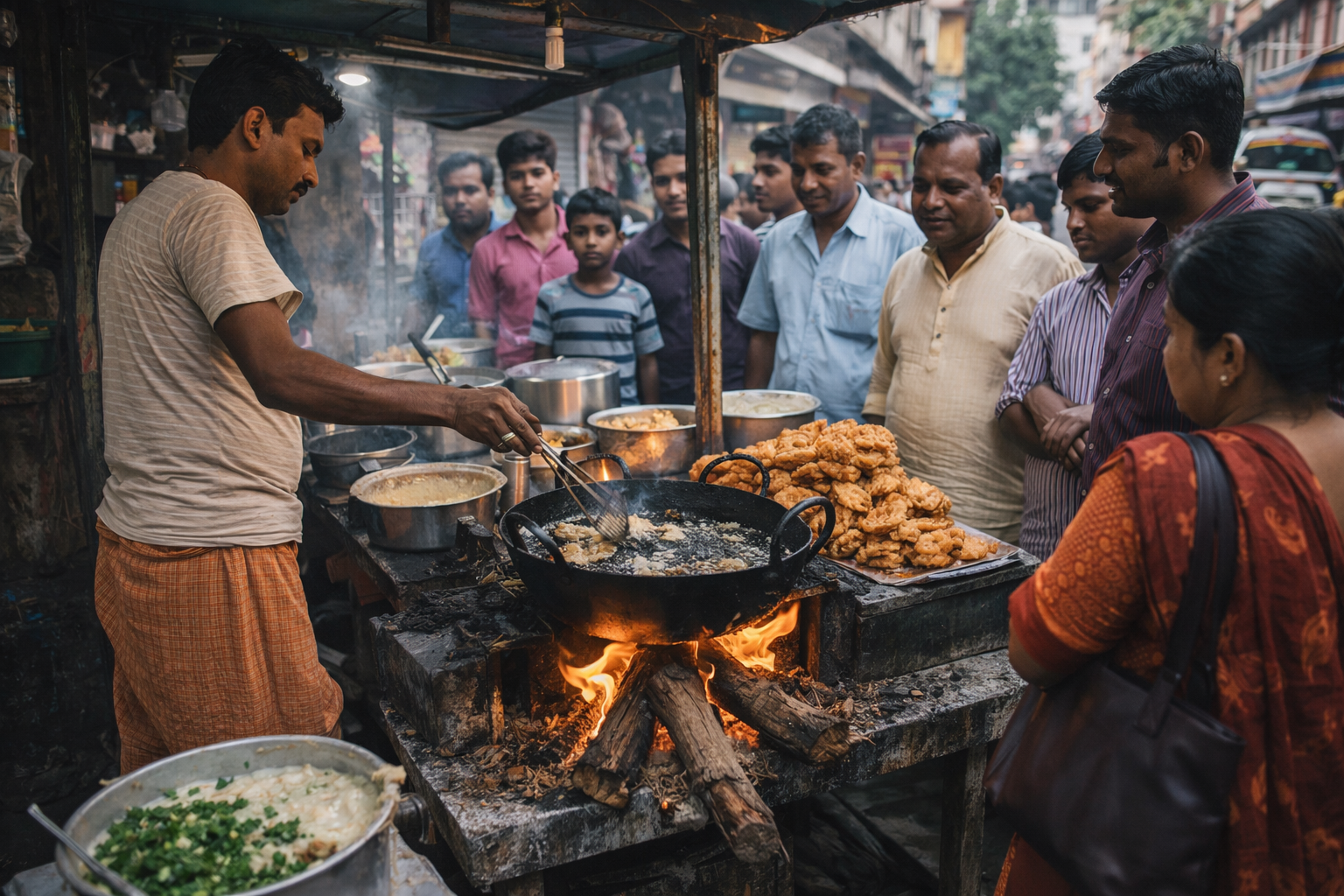
Meanwhile, the roadside eateries in Kolkata have been facing the brunt of the shortages of LPG cylinders.
These eateries are struggling due to the simultaneous increase in the prices of both cooking oil and LPG.
Many restaurants have also shut shop, and others have cut down on their menus.
The owner of Eastern Sweets and Confectioners, a popular sweet shop in the Dumdum area in Kolkata, told Invezz they have been using firewood as cylinders are still not available.
A Chinese restaurant named Sei Vui in the heart of Kolkata has also closed due to a shortage of LPG cylinders.
Experts believe that geopolitical risk premiums could also have ripple effects on the country’s LPG supply.
“Even without a full supply disruption, geopolitical risk premiums alone can drive short-term volatility in LPG and broader natural gas markets,” Mehmud Iqbal, manager – technology & market development at FortisBC, a British Columbia based regulated utility that provides natural gas and electricity, told Invezz.
“If tensions escalate or shipping through key chokepoints such as the Strait of Hormuz becomes constrained, the ripple effects could extend beyond LPG into LNG and crude markets as traders reassess supply security across the region.”
Geopolitical risk, alternative routes, and logistical hurdles
While the universally accepted strategy for successful diversification is to avoid “putting all eggs in one basket,” the current logistics environment poses a significant challenge to this principle.
This disruption in the Strait of Hormuz has primarily benefited North American exporters, who have cemented their position as a reliable safe haven for buyers, according to Mind Money’s Isaev.
These buyers are demonstrating a willingness to pay a premium to secure guaranteed supply chains, he added.
“In this respect, India looks more positioned to save and risk (somewhat) than to overpay and wait,” Isaev said.
“Therefore, Russia and West Africa are both possible alternative choices, but they are hindered by similar logistical bottlenecks, as well as, in the case of dealing with Russia, complicated payment channels.”
In the event of high costs or limited availability of gas, alternative fuels can temporarily meet a portion of the demand. India’s energy landscape is still heavily reliant on fuel oil and especially coal.
According to some analysts, approximately 20% of the country’s current LNG consumption, particularly for power generation and specific industrial needs, could potentially be substituted with coal in the near term.
At the same time, the Middle East remains central to India’s LPG balance.
In recent years, Qatar has been a principal external supplier of LPG to India, typically providing approximately 4–5 million tonnes annually.
“Replacing volumes of that scale would inevitably take time,” Isaev noted.
A swift solution is unlikely by redirecting supply from the US or West Africa.
Supply from the Middle East takes only about a week to arrive, in stark contrast to the almost 45-day transit time from the US Gulf Coast, according to Isaev.
“That said, even as American exporters ramp up by 2-3 Bcf/d, they simply cannot bridge the Qatari-sized hole in the market overnight,” he said.
The post Mideast turmoil exposes India's weak LPG logistics; eateries face the heat appeared first on Invezz