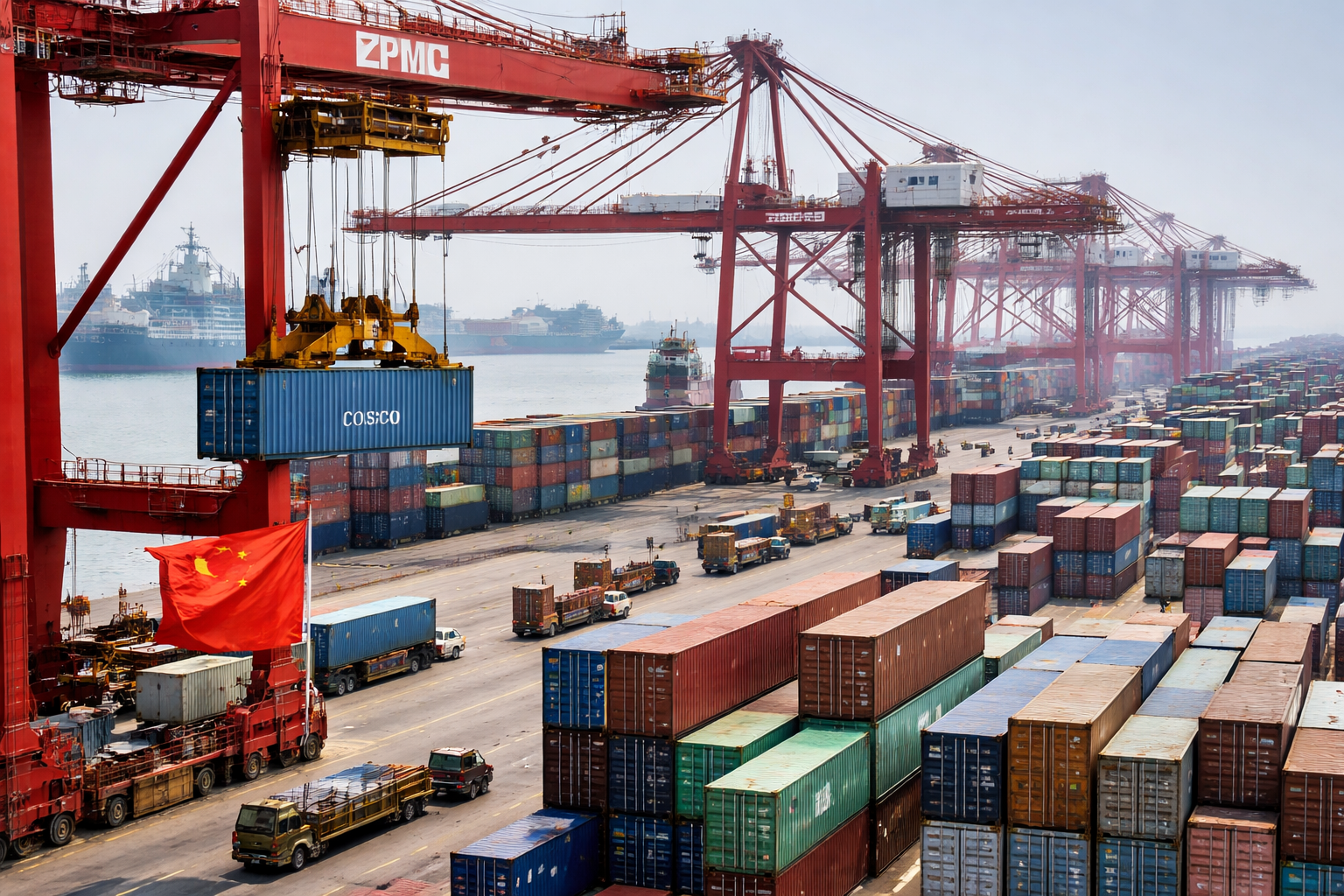
China trade surplus hits record $213B as exports surge 21.8%
China’s trade surplus climbed to a record level in the combined January–February period as exports and imports both exceeded market expectations, highlighting the resilience of the world’s second-largest economy despite ongoing trade tensions with the United States.
China reported a trade surplus of $213.62 billion in the first two months of 2026, surpassing economists’ expectations of about $196.6 billion and following a record surplus of $1.189 trillion recorded in 2025.
The Chinese government typically combines trade data for January and February to smooth distortions caused by the shifting timing of the Lunar New Year holiday.
The latest figures showed strong momentum in both exports and imports, signaling robust external demand and steady domestic consumption at the start of the year.
Exports and imports beat forecasts
China’s exports rose 21.8% year on year in the combined January–February period, reaching $656.58 billion.
The figure far exceeded the 7.1% growth expected by economists surveyed by Reuters and marked the fastest pace of export growth since October 2021.
The sharp increase also represented a significant acceleration from the 6.6% growth recorded in December.
Imports also surprised on the upside, climbing 19.8% year on year to $442.96 billion.
The growth rate was well above the 6.3% increase forecast by economists and represented the strongest import expansion since early 2022.
The increase followed a 5.7% rise recorded in December.
Analysts said the robust trade performance reflected solid global demand and a strong start to the year for China’s economy.
Some economists noted that the timing of the Lunar New Year may have influenced the year-on-year growth figures.
Trade patterns shift away from the US
Despite the strong overall trade performance, China’s trade relationship with the United States weakened during the period.
Government data showed that trade with the US declined 16.9% to 609.71 billion yuan ($88.22 billion) compared with the same period a year earlier.
At the same time, trade with other major partners expanded significantly.
Trade with the European Union rose 19.9% to 998.94 billion yuan, while trade with the Association of Southeast Asian Nations (ASEAN) increased 20.3% to reach 1.24 trillion yuan.
The data comes amid continuing trade tensions between Washington and Beijing.
The two countries have been locked in a tariff dispute since US President Donald Trump returned to the White House in January 2025, with both sides repeatedly adjusting tariffs on each other’s goods throughout the year.
Relations improved somewhat after a meeting between Trump and Chinese President Xi Jinping on the sidelines of the APEC summit in Busan, South Korea, in October.
Inflation and policy outlook
The trade data was released shortly after figures showed that China’s consumer inflation had accelerated.
China’s consumer price index rose 1.3% in February compared with a year earlier, exceeding economists’ expectations for a 0.8% increase.
The reading followed a 0.2% increase recorded in January and represented the strongest rebound in inflation since January 2023.
The data also coincided with China’s annual “Two Sessions” policy meetings, where Premier Li Qiang outlined the country’s economic targets.
At the meetings, Li set a GDP growth target range of 4.5% to 5%, the lowest growth target since the early 1990s.
Zhang said the stronger trade performance, combined with the relatively modest growth target, suggests policymakers may not need to introduce additional stimulus in the near term.
Meanwhile, US tariffs on Chinese goods remain partly in place.
Although some tariffs imposed under the International Emergency Economic Powers Act were struck down by the Supreme Court, earlier duties under Section 301 of the Trade Act of 1974 and Section 232 of the Trade Expansion Act of 1962 remain in force for certain products.
According to business intelligence firm China Briefing, the effective tariff rate on many Chinese exports to the United States remains close to 30%, still among the highest applied to any country.
The post China trade surplus hits record $213B as exports surge 21.8% appeared first on Invezz